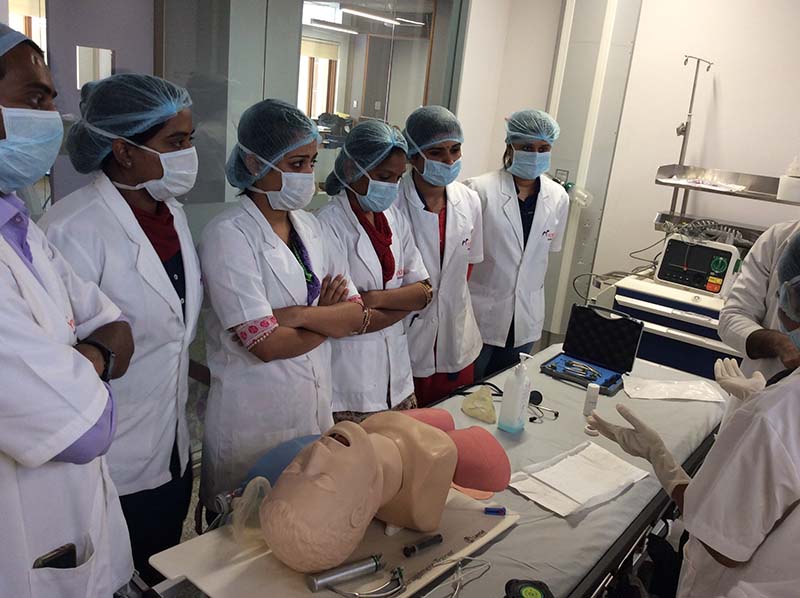
Healthcare education is undergoing a revolution — one where traditional classroom learning is no longer enough to prepare professionals for the complexities of real-world patient care. At the forefront of this transformation are simulation labs, immersive environments that replicate clinical scenarios with precision and realism. These labs are not just training spaces — they are bridges between theory and practice, preparing clinicians, nurses, and allied health professionals for the dynamic pressures of modern healthcare.
What Are Simulation Labs?
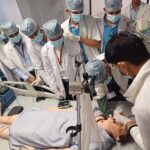
Simulation labs are controlled, realistic clinical environments equipped with high-fidelity manikins, medical equipment, and scenario-based training tools. They allow learners to practice procedures, make clinical decisions, and apply critical thinking in lifelike settings — without risking patient safety. Eagle Gate College
At YUVA Healthcare, our simulation labs follow international standards and are built around immersive learning experiences that mimic real hospital workflows, from ICU emergencies to operating room scenarios. Yuva Healthcare
Why Simulation Matters More Than Ever
Healthcare has become increasingly complex. Rapid technological advancements, evolving treatment protocols, and the pressure to deliver error-free care demand more than textbook knowledge. Simulation labs address these challenges by offering:
1. Hands-On Skill Development
Simulation allows trainees to perform clinical tasks repeatedly until mastery — from IV insertions to advanced resuscitation techniques — fostering both procedural fluency and confidence. Eagle Gate College
2. Safe Learning Environment
Mistakes in healthcare can have serious consequences. Simulation training creates a risk-free space where learners can make decisions, see outcomes, and improve without harm to patients. IIEMS
3. Preparedness for High-Risk Scenarios
Rare but critical events — such as cardiac arrests or traumatic emergencies — are difficult to encounter during routine clinical rotations. Simulation exposes learners to these scenarios repeatedly, ensuring readiness when it matters most. EMS Works
4. Enhanced Teamwork and Communication
Modern healthcare is delivered by multidisciplinary teams. Simulation exercises promote collaboration among doctors, nurses, and allied health staff, improving communication and patient outcomes in real clinical settings. IIEMS
5. Standardized Training and Assessment
Simulation provides consistent learning experiences, enabling fair evaluation of skill competency across all learners rather than relying on variable clinical exposure. SAGE University Bhopal
How YUVA Healthcare Leads the Change
YUVA Healthcare is committed to redefining healthcare education in India through state-of-the-art simulation labs and our Immersive Learning® methodology. Our training environments:
✔ Feature realistic ICU, operating theatre, and imaging simulations. Yuva Healthcare
✔ Are aligned with national education standards and emerging best practices. Yuva Healthcare
✔ Combine hands-on practice with expert feedback and debriefing. Yuva Healthcare
These simulation experiences help learners translate knowledge into clinical competence, making them workplace-ready from day one.
At YUVA Healthcare, we continue to adopt innovative methods that ensure our learners are prepared, confident, and capable of delivering safe, high-quality care — today and in the future.